

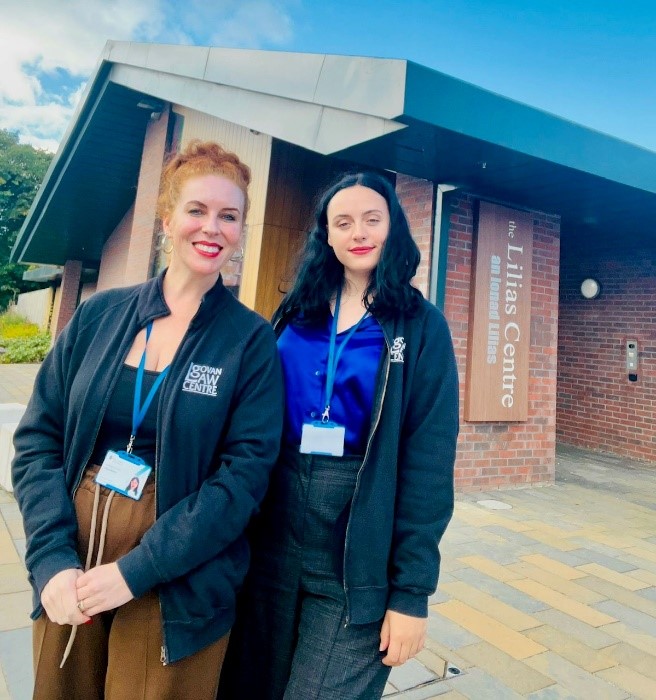
Last month, our Head of Prevention of Homeless Services, Senior Solicitor, Lorna Walker, and our Women’s Rights Project (WRP) Solicitor, Charis Brooks attended the Lilias Centre for a tour of the facilities and then had an open discussion with the service users.
Currently there are 22 women in the prison, which has a capacity of 24. Lorna and Charis explained the work of the WRP at Govan Law Centre, and the services that we can offer. They explained what rights to homeless assistance the women had and how to contact us if these rights were not being met.
They shared recent anonymised cases of clients the WRP has helped and what to expect from our service. The women shared personal accounts of periods of rough sleeping and/or being stuck in hostels or sofa surfing which lead to exploitation to avoid rough sleeping.
One woman described periods of rough sleeping and sofa surfing in dangerous environments following her previous liberation date, which often leads to a cycle of abuse and recidivism. It was noted that though there should be transitions in place from custody to homelessness accommodation this is not often the case. This provides all the more incentive for the Women’s Rights Project to uphold these statutory duties.
WRP Case Study
A young woman, age 21, presented to our WRP outreach with our partnership organisation, the Simon Community, explaining that she was sofa surfing and despite presenting as homeless no application had been taken nor offer of temporary accommodation been made.
Our WRP took instructions from the client to threaten judicial review against the local authority in respect of breaches of sections 28 and 29 of the Housing (Scotland) Act 1987. The client was offered temporary accommodation that day, which was her own room within a hotel. The WRP took instructions to obtain medical information from the client with the view of challenging the local authority in respect of a breach of Article 4(b) of the Homeless Persons (Unsuitable Accommodation) (Scotland) Order 2014 as the hotel accommodation was unsuitable in terms of its negative effect on her mental health.
Specifically, the client had a history of gender based violence. The client was aware of the challenge under 4(b) though opted to stay at the hotel for the 7 day period in order to effect a faster challenge under Article 5(e) the fact the hotel accommodation failed to meet the basic standards in its lack of kitchen or living room facilities. Following the WRP’s intervention, and instruction of our solicitor advocate to Petition for Judicial Review in respect of these breaches, the local authority offered the client a suitable temporary furnished flat (TFF).
