
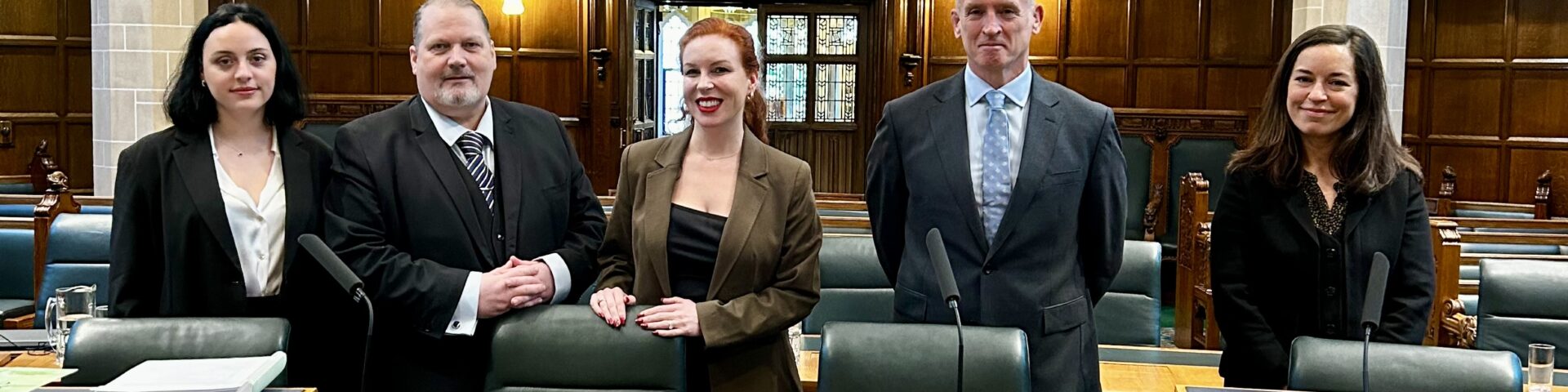
Govan Law Centre lawyers appeared before the UK Supreme Court yesterday (Tuesday, 14 January 2025) in the case of X v Glasgow City Council (Shelter Scotland intervening). The Court made avizandum and a judgment will be handed down in due course.
The issue before the Court was whether temporary (interim) homeless accommodation provided by local authorities pursuant to the section 29 duty of the Housing (Scotland) Act 1987 (the “1987 Act”) must meet the specific needs of individual members of the household in order to be suitable for the purposes of section 29(3) of the 1987 Act and article 4(b) of the Homeless Persons (Unsuitable Accommodation) (Scotland) Order 2014 (the “2014 Order”).
Facts
The appeal concerns a decision of a local authority in relation to the provision of temporary homeless accommodation under the Housing (Scotland) Act 1987 (the “HA 1987”). The Appellant’s household consists of the Appellant, her husband, three daughters and a son. The Appellant’s son has been diagnosed as autistic and is disabled within the meaning of section 6 of the Equality Act 2010 (“EA10”).
On 4 February 2020 the Appellant and her husband were notified that they had been granted refugee status. This mean that they, and their family, were no longer entitled to accommodation provided by the Home Office, they became homeless persons and the obligation to house them passed to the Respondent. The Respondent provided them with a four-apartment property as temporary accommodation (the “Property”).
The Respondent investigated the Appellant’s permanent accommodation needs. A report dated 21 July 2021 concluded that the family needed a “5-apartment property in order to accommodate their son’s additional support needs and a garden would also be beneficial with regard to this.” The Appellant, on 10 August 2021, requested that the Respondent review the suitability of the Property and move the family to alternative housing. A senior homeless worker at the Respondent stated that it had not been possible to provide “a further temporary furnished flat at this stage due to a lack of this type of accommodation becoming available.”
A caseworker at the Respondent explained in an affidavit that the Respondent depends on registered social landlords (housing associations) to source temporary accommodation. There are very few five-apartment properties and such properties rarely become available. The Appellant brought a judicial review against the Respondent’s failure to provide her and her family five-apartment accommodation. The Outer House of the Court of Session held that the Respondent had acted unlawfully by providing the Appellant with unsuitable temporary accommodation.
A video of the appeal hearing is available on the UK Supreme Court’s website here: https://www.supremecourt.uk/cases/uksc-2023-0068
For the appellant: Roddy Dunlop KC, Dean of the Faculty of Advocates and Mike Dailly, Solicitor Advocate appeared as counsel; instructing solicitors Rachel Moon, Partner, Lorna Walker, Senior Solicitor and Charis Brooks, Solicitor; Laura McDonagh, Partner at Drummond Miller LLP acted as Edinburgh and London agents. David Johnston KC and Graeme Middleton, Advocate appeared as counsel for the respondent; instructed by Harper MacLeod LLP and Glasgow City Council’s legal department.
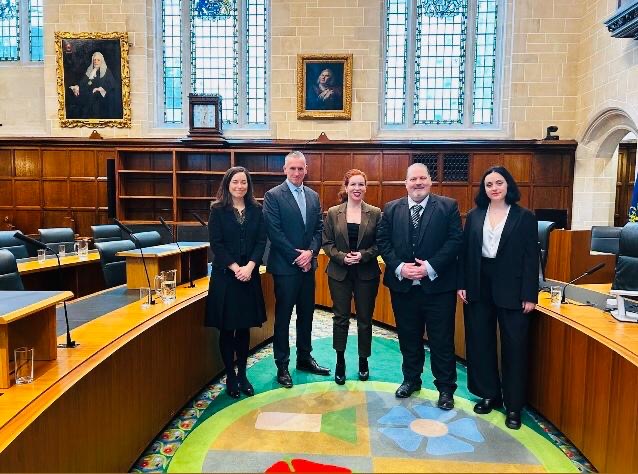


Rachel Moon, Roddy Dunlop KC, Lorna Walker, Mike Dailly and Charis Brooks

